Guides ·
Black holes explained for kids, with 10 amazing facts
What a black hole is, how one is made, why nothing gets out and how scientists see something that is black, explained simply for kids, with ten facts to share.
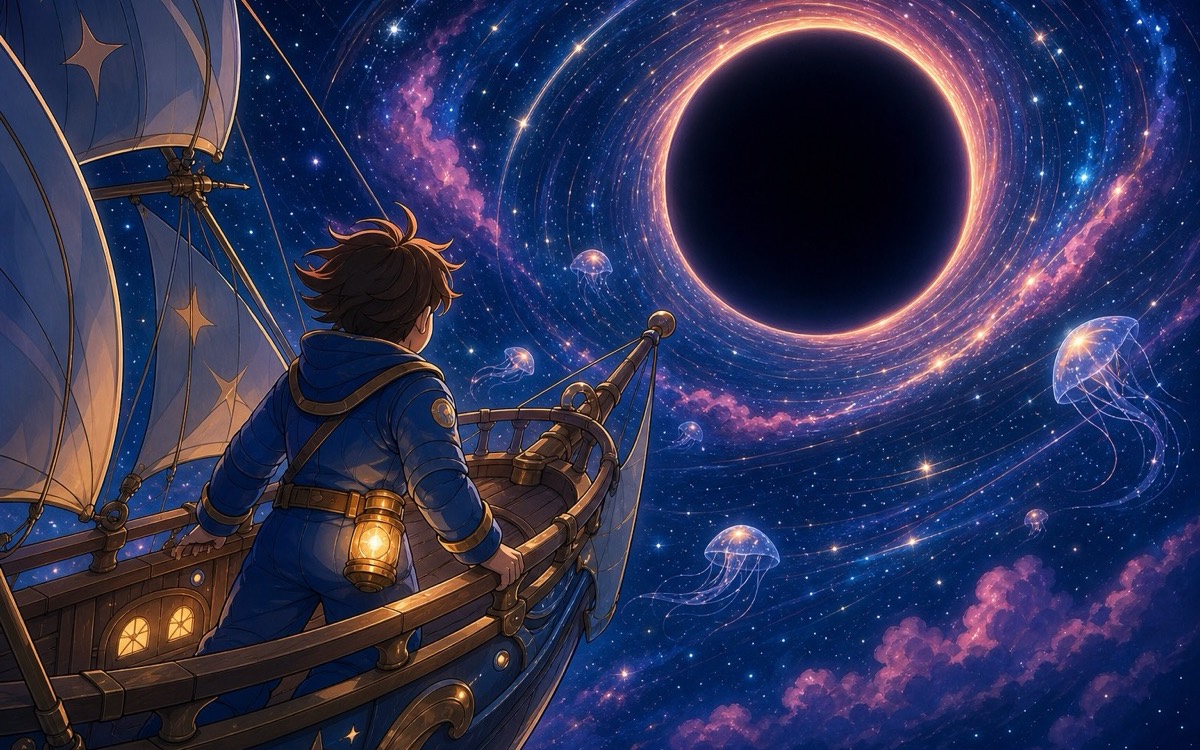
Short answer: a black hole is a place in space where so much stuff is squeezed into such a small space that its pull, called gravity, is stronger than anything else we know. Close to it, nothing can get away, not even light, which is the fastest thing in the universe. Because no light comes out, it looks black.
A black hole is not really a hole. It is not empty, and it is not a tunnel to somewhere else. It is more like the heaviest thing you can imagine, packed into the smallest space you can imagine.
What is a black hole, simply?
Everything with mass pulls on everything else. That pull is gravity. It is why a ball falls back down when you throw it up, and why the Moon goes around the Earth.
Throw a ball harder and it goes higher. Throw it fast enough (about 11 kilometres every second) and it would never come back down: it would escape the Earth. Scientists call that the escape speed.
Now imagine squeezing the whole Earth until it is the size of a marble. It would weigh exactly the same, but its pull near the surface would be enormous, and the escape speed would be faster than light. Light travels about 300,000 kilometres every second, and nothing can go faster. So nothing could escape. That squeezed marble would be a black hole.
How is a black hole made?
Most black holes are made when a very big star runs out of fuel.
A star is a giant ball of burning gas. For millions or billions of years, the heat pushing out from its middle balances the gravity pulling in. When a star much bigger than our Sun runs out of fuel, nothing is pushing out any more. Its middle collapses in a fraction of a second, the outside is blown off in a huge explosion called a supernova, and what is left in the middle can be squeezed into a black hole.
Our Sun is not big enough to do this. It will never become a black hole.
What is the event horizon?
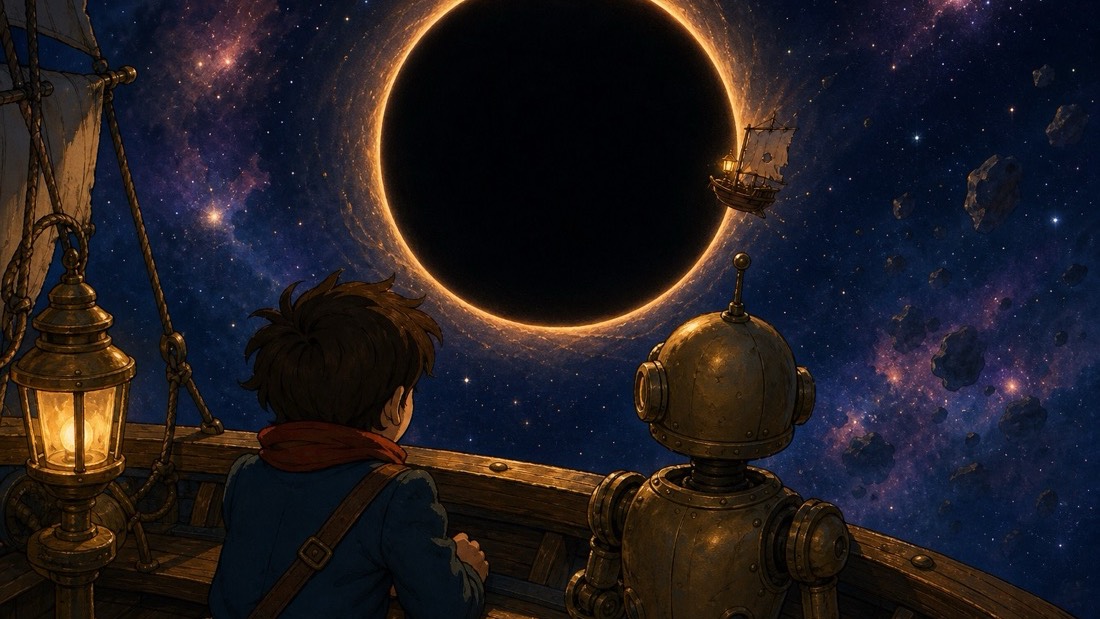
Around every black hole there is an invisible line called the event horizon. It is the point of no return. Outside it, something moving fast enough can still get away. Inside it, nothing can, not even light.
The event horizon is not a wall or a surface. A spaceship crossing it would not bump into anything. It just could never come back out.
How big is a black hole?
That depends on how much stuff is inside it.
- A black hole made from a star might weigh as much as 10 Suns. Its event horizon would be only about 60 kilometres across: you could drive across it in an hour.
- At the middle of our galaxy, the Milky Way, there is a supermassive black hole called Sagittarius A* (say "Sagittarius A star"). It weighs about 4 million Suns.
- Some galaxies have even bigger ones. The black hole in a galaxy called M87 weighs about 6.5 billion Suns. Its event horizon is wider than the paths of all the planets around our Sun.
If black holes are black, how do scientists see them?
You can't see a black hole itself, but you can see what it does to things around it.
- Glowing gas. Gas falling towards a black hole swirls around it like water around a drain, faster and faster, and gets so hot that it glows. In 2019 a group of telescopes all around the world, working together as the Event Horizon Telescope, took the first picture of this: a bright ring around the dark shadow of the black hole in M87. In 2022 they did the same for Sagittarius A*.
- Stars that whizz around nothing. Near the middle of our galaxy, astronomers watched stars racing around a spot where nothing could be seen. Only something very heavy and very small could swing them around like that.
- Bent light. A black hole's gravity bends light from the stars behind it, the way a glass marble bends what you see through it. Stars can look stretched, or appear in the wrong place, or seem to be missing.
- Ripples in space. In 2015, special detectors on Earth felt tiny ripples in space itself, called gravitational waves, made when two black holes crashed into each other over a billion years ago.
Does time really slow down near a black hole?
Yes. This is one of the strangest true things in science. The stronger gravity is, the slower time passes. Albert Einstein worked this out over a hundred years ago, and it has been measured many times since.
You don't need a black hole to see it. Clocks on the satellites that run GPS are a little farther from the Earth's gravity than clocks on the ground, so they tick very slightly faster, and engineers have to correct them every day. Near a black hole, the difference would be enormous: an astronaut who spent a while close to one could come home to find that much more time had passed for everyone else.
What would happen if you fell into a black hole?
Nobody could go and check, so this is what scientists' maths says.
Near a small black hole, gravity pulls much harder on the part of you that is closer than on the part that is farther away. You would be stretched out long and thin, like a noodle. Scientists really do call this spaghettification.
Near a giant black hole, the stretching is much gentler, and you could cross the event horizon without feeling anything special. But you could never come back out to tell anyone about it.
Could a black hole swallow the Earth?
No. The closest black hole we know of, called Gaia BH1, is about 1,560 light-years away: light from it takes 1,560 years to reach us. Black holes don't move around hunting for things to swallow. From far away, a black hole pulls just like a star of the same weight would. If the Sun were somehow swapped for a black hole of the same weight, the Earth would keep going around it exactly as it does now (although it would get very cold and dark).
10 amazing black hole facts for kids
- Light is the fastest thing in the universe, and it still can't escape a black hole.
- A black hole is not empty: it is the most squashed-together stuff there is.
- If the Earth were squeezed into a black hole, it would be about the size of a marble.
- Our Sun will never become a black hole. It isn't big enough.
- There is a black hole weighing about 4 million Suns at the middle of our galaxy.
- The first picture of a black hole's shadow was taken in 2019, using telescopes all over the world at once.
- Near a black hole, time passes more slowly.
- Being stretched like a noodle by a black hole is really called spaghettification.
- Two black holes crashing together make ripples in space that scientists can detect on Earth.
- The name "black hole" only became popular in the 1960s, long after scientists first worked out that such things might exist.
Explore a black hole in a story
In our space adventure, The Voice at the Edge of the Black Hole, your child sails a tiny ship with a silver solar sail to the edge of a black hole, with Cog, a clockwork robot, for company. Along the way they use real science to solve problems: they find the black hole by the stars that are missing, steer with light pushing on the sail, and notice that time runs differently close to the edge.
The adventure says what is real and what is made up. Black holes, solar sails, bent light and slower time are real. The voice calling for help from the edge of the black hole is the story's own invention. You can play the first moment free, no sign-up needed, or see our other space games for kids.
Roll for Wonder
A tabletop adventure your child leads.
Explore illustrated worlds, meet characters and solve problems together. Play a moment of it right now, no sign-up needed.