Guides ·
How to write a choose-your-path story with kids, free template
Step by step, write a choose-your-path story with a child of 6 to 12, from the first problem to the endings, with a free printable story map.
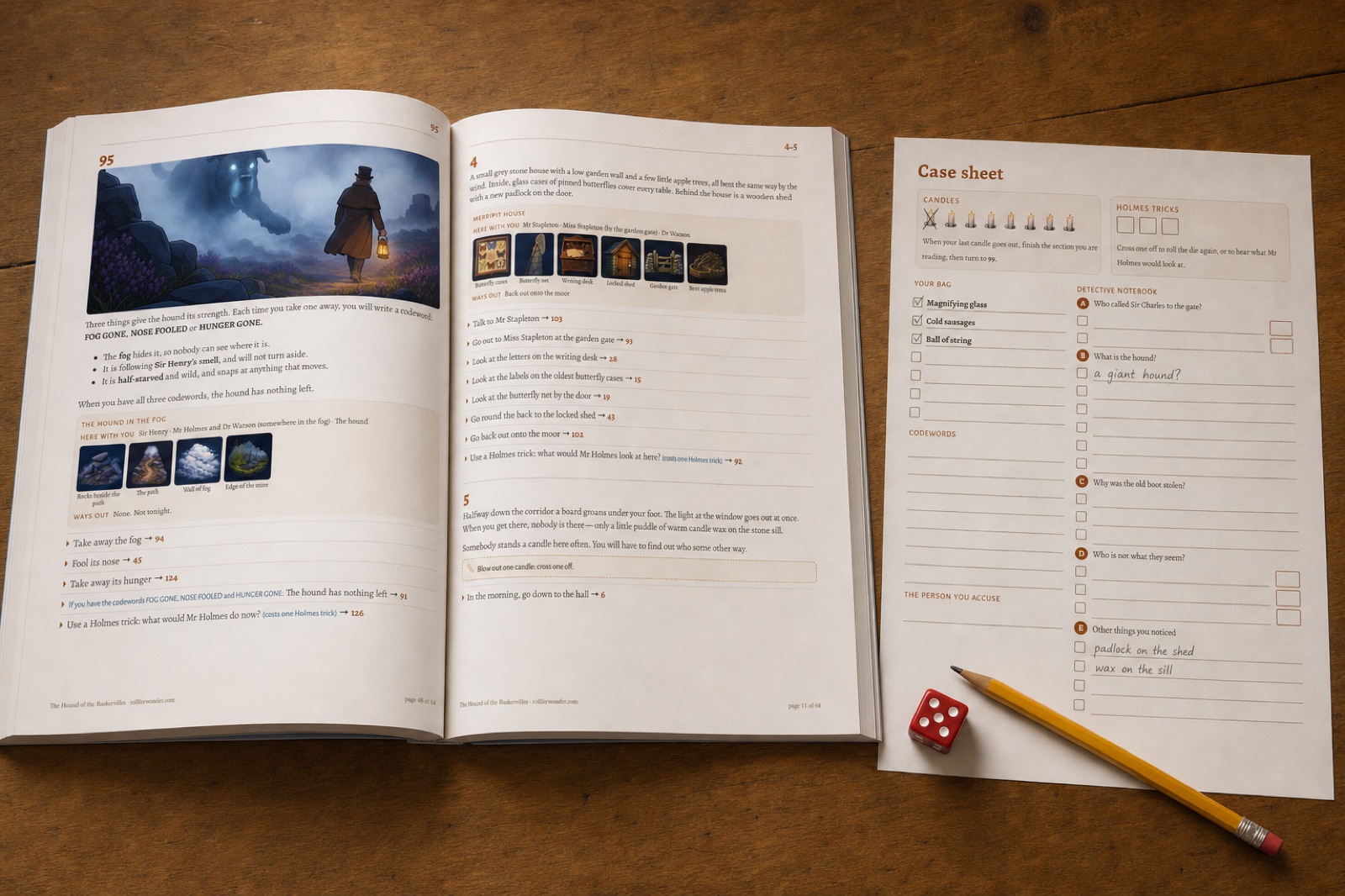
Short answer: start with one hero and one problem, draw a small map where every arrow is a choice, then write each box as a short numbered section that ends with a question. Seven to twelve sections make a whole story. Our free template gives you the planning page, the map and the section cards to print.
Download the free template: US Letter (PDF) · A4 (PDF). Four pages: plan your story, the story map, and eight section cards. Free to print and to share, with a class too.
Why it's worth an afternoon
Children who love choose-your-path books soon want to make one. It's one of the best writing exercises there is, and it doesn't feel like one. Every section has to end with a real choice, so the child has to think about what the reader wants and what could happen next. They write short pieces instead of one long page, and they get a finished book at the end, which a sibling or a grandparent can actually play.
What you need
- The template, printed (or plain paper and a pencil)
- One ordinary six-sided die, if you want a moment of luck
- About an hour for a first story. It can also be spread over a few days.
Step 1: one hero, one problem
Fill in the first page together. Ask the questions on it and write down the child's answers as they say them:
- Who is the hero? It can be the child, a pet, a robot or a mouse.
- Where does it happen? One place is enough: a castle, a school, a spaceship, the garden.
- What has gone wrong? This is the most important box. "The class hamster has escaped" is a better start than "a magic kingdom". Something small and urgent drives the whole story.
- Who helps, and who is in the way?
- What does the hero carry? One or two things that will be useful later.
- How can it end? One best ending and one that is not quite. Nobody has to die for it to be exciting: the hamster can end up on the wrong bus.
Step 2: draw the map before writing
The second page of the template is a small tree. The top box is section 1, the start. Each arrow is a choice. Two choices lead to two boxes, each with two choices again, and then come the endings.
Write only two or three words in each box: "follows the crumbs", "asks the teacher", "looks under the stage". The map shows the whole story on one page, so nobody gets lost in the middle.
A tip from real gamebooks: two paths may lead to the same box. It saves writing and makes the map feel bigger than it is.
Step 3: write each box as a section
Now take the section cards. One card for each box on the map:
- Three to five sentences. Where the hero is, what they see or hear, and one detail that matters.
- End with a question. "What do you do?"
- Two choices, each with a number. "If you follow the crumbs, turn to 4. If you ask the teacher, turn to 7."
- Endings say they are endings. Tick "This is an ending" and write how it turns out.
Younger children (6 and 7) can tell each section out loud while you write it down. From about 8, most can write the cards themselves.
Step 4: add a die, or a clue
Once the paths work, add one moment of luck. On the card it looks like this: "Roll the die: 4 or more, turn to 9. Less, turn to 5." The less branch should never end the story. It costs something or makes things harder, and the story goes on.
Children of 10 to 12 often want a clue too: something the reader writes down in one section and needs in another. "If you have the key on your sheet, turn to 11."
Step 5: mix up the numbers, then test it
Real gamebooks don't put section 2 right after section 1, so nobody can just read on and peek. Number the cards in any order you like, then check every "turn to" again.
Then the best part: give the finished cards to someone else and watch them play. The author will want to change things straight away. That's what writers do.
Tips by age
- Ages 6 and 7: five to seven sections, no die. The grown-up writes, the child decides everything.
- Ages 8 and 9: seven to ten sections, one die roll, the child writes.
- Ages 10 to 12: ten to twelve sections or more, a die, a clue to carry, and a second ending to find.
Want to see a finished one first?
Download the first chapter of our Sherlock Holmes gamebook for free: numbered sections, a die and a case sheet, the way a published one looks. Then try writing your own with the template. Our printable gamebooks cover twelve stories, from the Minotaur's labyrinth to the planets.
Roll for Wonder
A tabletop adventure your child leads.
Explore illustrated worlds, meet characters and solve problems together. Play a moment of it right now, no sign-up needed.