Guides ·
Planets for kids: the 8 planets of our solar system in order
The eight planets of our solar system explained simply for kids, in order from the Sun, with the most surprising true fact about each one.
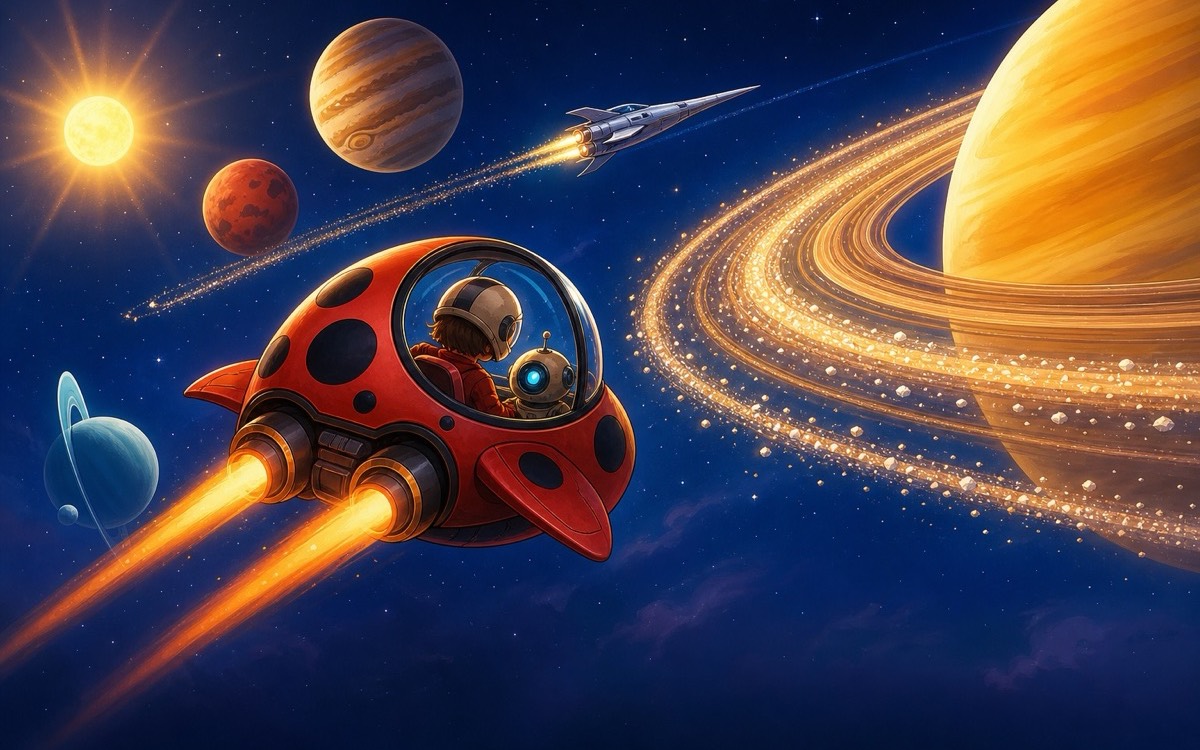
Short answer: our solar system has eight planets going around the Sun. In order from the Sun they are Mercury, Venus, Earth, Mars, Jupiter, Saturn, Uranus and Neptune. The first four are small and rocky. The last four are giants made mostly of gas and ice, and none of them has any ground you could stand on.
An easy way to remember the order: My Very Easy Method Just Speeds Up Naming.
What is a planet?
A planet is a big, round world that travels around a star. It is big enough for its own gravity to pull it into a ball, and it has cleared the space along its path of most other things.
Our star is the Sun. Everything that goes around it, the planets, their moons, the dwarf planets like Pluto, and millions of asteroids and comets, is called the solar system. "Sol" is the Latin word for the Sun.
Mercury: the smallest, and closest to the Sun
Mercury is only a little bigger than our Moon. It is so close to the Sun that the daytime reaches about 430 °C, hot enough to melt lead.
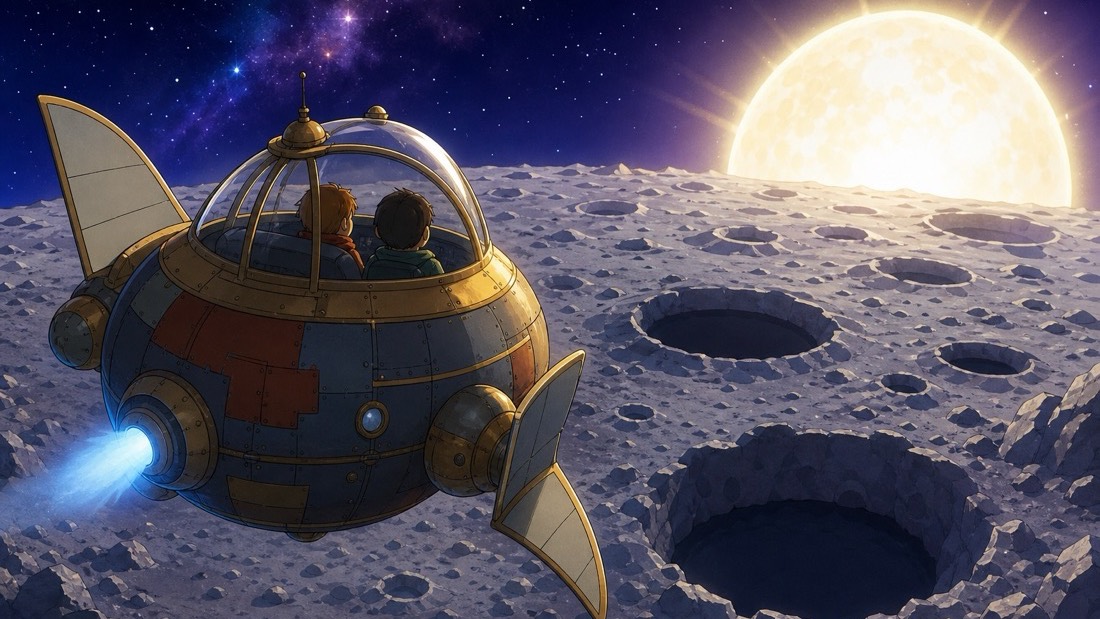
But Mercury has almost no air to hold the heat in, so at night it drops to about −180 °C. And at its north and south poles there are deep craters that the Sun never shines into. Scientists have found ice at the bottom of them, on the planet nearest the Sun.
Venus: the hottest planet
Venus is closer to the Sun than Earth, but it is not the closest planet. It is still the hottest, about 465 °C everywhere, day and night. Its air is so thick that it traps the heat like a blanket. Standing on the ground would feel like being nearly a kilometre deep in the ocean.
Its clouds are not made of water like ours. They are made of tiny drops of acid.
Venus also spins backwards compared with most planets, so on Venus the Sun rises in the west. It spins so slowly that one day on Venus is longer than its whole year.
Earth: the only planet we know has life
Earth is the only planet we know of with liquid water on its surface and living things. It has one moon. The Moon has no air at all, so there is no sound on the Moon: astronauts talk to each other by radio.
Mars: the red planet
Mars is red because its dust contains rust, iron mixed with oxygen. It has the tallest volcano in the solar system, Olympus Mons, about 22 kilometres high: more than twice as tall as Mount Everest.
Mars has huge dust storms. Sometimes a single storm covers the whole planet for weeks, but the top of Olympus Mons can stick out above most of them.
The asteroid belt: much emptier than in films
Between Mars and Jupiter there are millions of rocks going around the Sun, called asteroids. In films, spaceships dodge through crowded walls of tumbling rocks. In real life the belt is mostly empty space: the asteroids are usually hundreds of thousands of kilometres apart. Spacecraft fly straight through without ever coming close to one.
Small asteroids pull so weakly that you would weigh less than a feather on them. One good jump could send you floating off into space.
Jupiter: the giant
Jupiter is the biggest planet: more than 1,300 Earths could fit inside it. It is made mostly of gas, so there is no ground to land on. Its Great Red Spot is a storm bigger than the whole Earth that has been blowing for hundreds of years.
Jupiter has more than 90 moons. One of them, Europa, is covered in ice, and under the ice there is a hidden salty ocean with more water than all of Earth's oceans put together.
Saturn: the planet with rings
Saturn's rings look solid from far away, but they are made of billions of pieces of ice and rock, some as small as grains of sand and some as big as houses. All of them travel around Saturn together, like cars in the same lane of a motorway.
Saturn is the lightest planet for its size. If there were a bathtub big enough, Saturn would float in it.
Uranus: the planet on its side
Long ago something probably knocked Uranus over, and now it rolls around the Sun on its side. Its rings stand up and down, like a target painted on a wall.
The tops of its clouds contain a gas that smells of rotten eggs. Only one spacecraft has ever visited Uranus: Voyager 2, in 1986.
Neptune: the windiest planet
Neptune is the farthest planet from the Sun, so cold and dark that it takes 165 Earth years to go around once. It has the fastest winds in the solar system, more than 2,000 kilometres an hour.
Its biggest moon, Triton, goes around Neptune backwards and shoots out icy geysers.
Where did Pluto go?
Pluto used to be called the ninth planet. In 2006 astronomers agreed that it is a dwarf planet: it is round and goes around the Sun, but it shares its path with many other icy worlds. Pluto is still there, and it is still a fascinating place: in 2015 the New Horizons spacecraft found a giant heart shape on it.
10 amazing planet facts for kids
- There is ice on Mercury, the planet nearest the Sun.
- Venus is hotter than Mercury, even though it is farther from the Sun.
- On Venus the Sun rises in the west.
- There is no sound on the Moon, because there is no air to carry it.
- Mars is red because its dust is rusty.
- Olympus Mons on Mars is more than twice as tall as Mount Everest.
- The asteroid belt is mostly empty space.
- More than 1,300 Earths could fit inside Jupiter.
- Saturn would float in a big enough bathtub.
- Uranus rolls around the Sun on its side, and its clouds smell of rotten eggs.
Race across the planets in a story
In our space adventure, Solar System – The Great Planet Race, your child flies a little ship they built themselves from the Moon all the way to Neptune, with Bip, a navigation robot who trusts numbers more than guesses. From every world they must bring back proof, and on half of them nobody can land. Each planet asks a riddle that only real science answers: watch for the flash on the silent Moon, look for ice where the Sun never shines, float a balloon of plain air on Venus, and fly through a gate that stands up and down around Uranus.
The adventure says what is real and what is made up. The planets and every fact the riddles rest on are real. The race, Bip and the champion whose ship keeps losing pieces are the story's own invention. You can play the first moment free, no sign-up needed, or see our other space games for kids.
Roll for Wonder
A tabletop adventure your child leads.
Explore illustrated worlds, meet characters and solve problems together. Play a moment of it right now, no sign-up needed.