Guides ·
Pompeii facts for kids: the Roman town under the volcano
What life was like in Pompeii, what happened when Vesuvius erupted in AD 79, and how the town was found again, explained simply, with 12 facts to share.
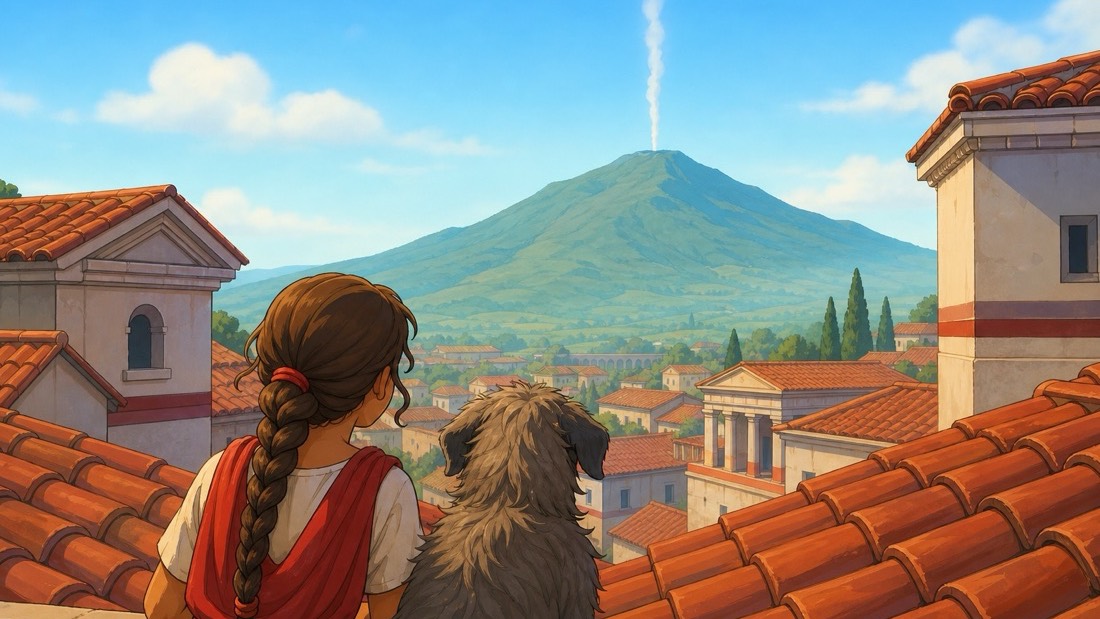
Short answer: Pompeii was a busy Roman town in southern Italy, at the foot of a mountain called Vesuvius. In AD 79, almost 2,000 years ago, Vesuvius turned out to be a volcano. It erupted and buried the whole town under ash and small stones. Many people got away, and some did not. Because the town stayed hidden under the ground for so long, today we can walk its streets and see how Romans really lived.
Where was Pompeii, and who lived there?
Pompeii stood near the Bay of Naples, in a green, sunny part of Italy with vineyards, olive trees and the sea close by. Historians think around ten to twelve thousand people lived there: bakers, shopkeepers, farmers, fishermen, rich families in big painted houses, and enslaved people who did much of the hard work.
It was part of the Roman Empire, so people spoke Latin, paid with Roman coins and went to Roman festivals. It was not a capital or a famous city in its own day. It was an ordinary town, and that is what makes it so special now: it shows us an ordinary day.
What was a day in Pompeii like?
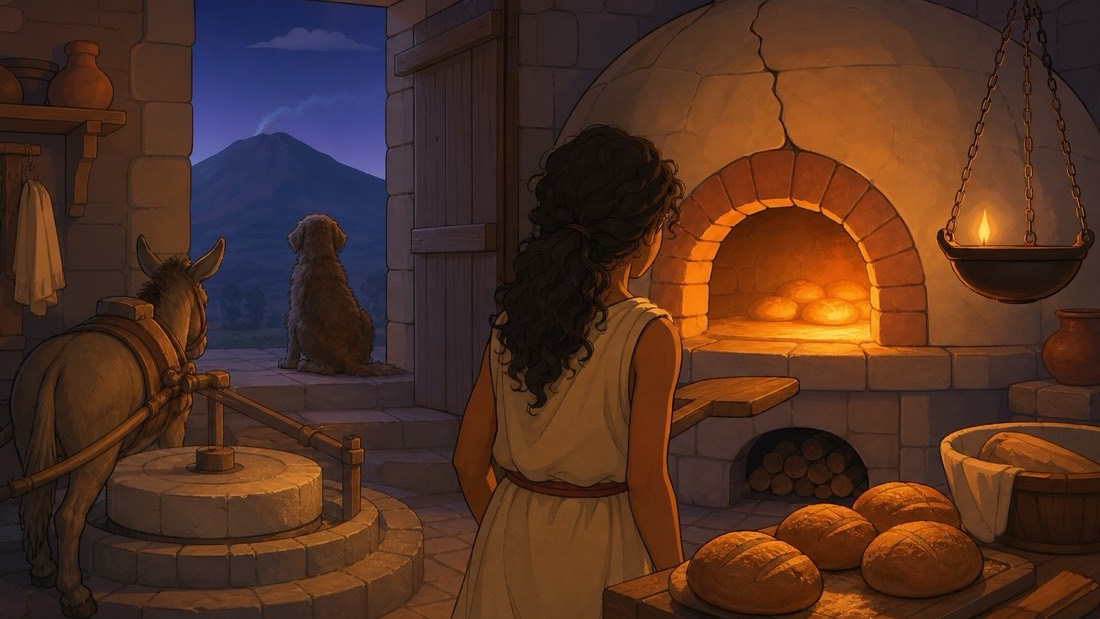
A day started early, at the bakery. Pompeii had more than thirty of them. Donkeys walked in circles to turn big stone mills that ground the grain, and the bread was baked in round, dome-shaped ovens, a lot like a pizza oven today.
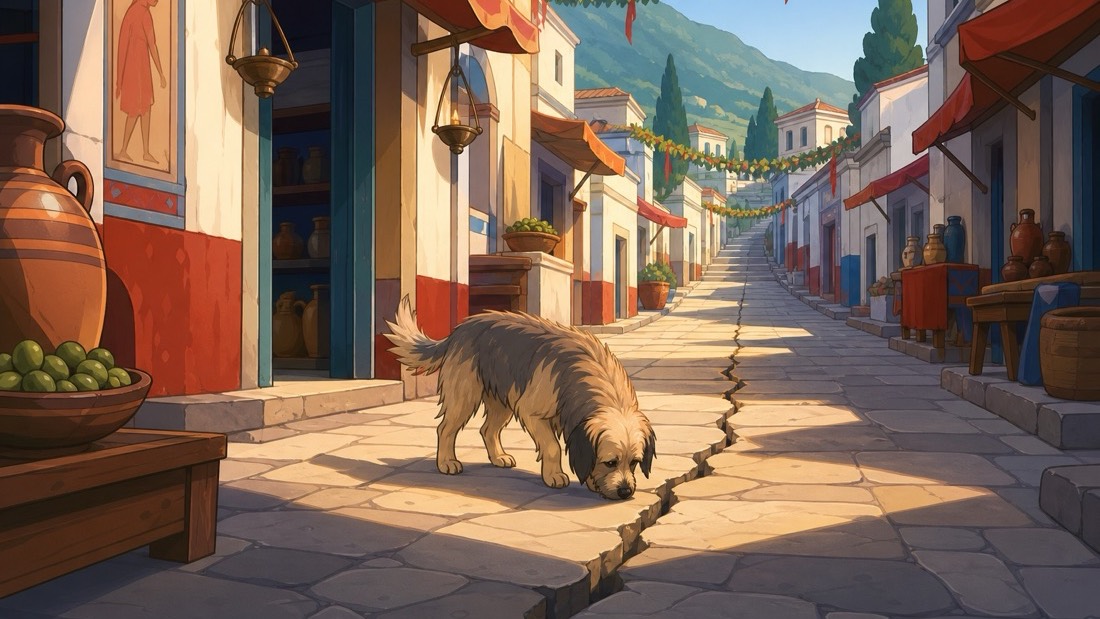
Then the streets filled up. There were shops and street-food counters with big jars set into the stone, where people bought hot food to eat on the go. Water came from fountains on the street corners. Many streets had stepping stones, so you could cross without stepping in the mud and dirty water, and cart wheels rolled through the gaps between them.
In the middle of town was the forum, a big open square with temples, a market, and the buildings where the town's leaders met. People also went to the baths, which were not just for washing: there were hot rooms, warm rooms and cold pools, and people met their friends there, the way you might meet at a swimming pool or a park.
People in Pompeii wrote on the walls, a lot. Archaeologists have found thousands of messages: notices for elections, adverts, names, jokes and "so-and-so was here". One person even wrote that they were amazed the wall had not fallen down under the weight of so much boring writing.
And at the door of one house, called the House of the Tragic Poet, there is a floor mosaic of a fierce dog on a chain with two words: "Cave canem". It means "Beware of the dog".
Did the people of Pompeii know Vesuvius was a volcano?
No. Vesuvius looked like a quiet green mountain covered in vineyards. It had been quiet for a very long time, and nobody living there remembered it as a volcano. A Greek writer named Strabo had noticed that the rocks at the top looked burnt, as if the mountain had once been on fire, but people did not think of it as a danger.
There were warnings, but nobody understood them. A big earthquake shook Pompeii about seventeen years before the eruption, and some buildings were still being repaired in AD 79. Small tremors shook the ground for days before the eruption too, but small earthquakes were common in that part of Italy, so people did not worry.
What happened when Vesuvius erupted?
Around midday, the mountain opened. A huge column of ash and stone shot up into the sky, higher than any cloud. Then it started to fall on Pompeii: grey ash and small, very light stones called pumice. They kept falling for hours, piling up in the streets and on the roofs, and the sky turned dark in the middle of the day.
Many people left in those first hours, on foot, in carts, or towards the sea, carrying what they could. Some stayed, hoping it would stop, or could not get out in time. The next morning, clouds of very hot ash and gas rushed down the mountain and reached the town. Within about a day, Pompeii was buried under several metres of ash and stone. The nearby town of Herculaneum was buried too.
When did it happen? For centuries the date was given as 24 August AD 79, from old copies of a Roman letter. But archaeologists have found clues that point to autumn, probably October: autumn fruit in the houses, warm clothes, and in 2018 a note written in charcoal on a wall with a date in the middle of October. Experts still argue about it, so the honest answer is: in AD 79, either late August or, as many now think, October.
How do we know what the eruption looked like?
From a teenager. Pliny the Younger was about seventeen and staying across the bay, at a place called Misenum, when his mother pointed out a strange cloud over the mountain. He said it looked like an umbrella pine, a kind of tree in Italy with a tall straight trunk and branches spreading flat at the top.
His uncle, Pliny the Elder, was an admiral in charge of the Roman fleet. He sailed across the bay with ships to help people near the mountain, and he did not come home. About twenty-five years later, Pliny the Younger wrote two letters to the historian Tacitus describing everything he had seen. They are the only eyewitness account of the eruption we have, and scientists still call this kind of eruption a Plinian eruption, after him.
Was the bread really still in the oven?
Yes. In 1862, archaeologists opened the oven of a Pompeii bakery and found about eighty loaves of bread inside, burnt hard and black, but still in one piece. Many loaves from Pompeii have lines cut across the top, often into eight pieces, like a cake, so they were easy to break and share.
How was Pompeii found again?
After the eruption, Pompeii disappeared under the ground, and people slowly forgot where it had been. Grass and fields grew on top. In the late 1500s, workers digging a water channel even tunnelled right under the town without knowing it was there.
Real digging began in 1748, ten years after digging began at nearby Herculaneum. At first nobody was sure which town it was. In 1763, diggers found an inscription with the town's name on it, and then they knew: this was Pompeii.
What are the plaster figures of Pompeii?
As the archaeologists dug, they sometimes found empty hollows in the hardened ash. Over time, the ash had set hard like a mould around people who had stayed in the town, and the hollow kept their shape. In 1863, an archaeologist named Giuseppe Fiorelli had the idea of pouring plaster into those hollows. When the plaster set, it showed the shape of a person, even the folds of their clothes.
These figures are a sad part of Pompeii, and they are shown with respect. They remind us that the people of Pompeii were real, like us. If your child is sensitive, it is fine to talk about them simply and not look at pictures.
What have archaeologists learned from Pompeii?
Almost everything about everyday life in a Roman town: what people ate (bread, fish, figs, olives, grapes), how they painted their houses in bright reds and yellows, what games children played, how shops worked, who people voted for, and even what made them laugh. Most Roman history was written about emperors and wars. Pompeii shows us bakers, shopkeepers and families.
The work is not finished. About a third of the town is still under the ground, and archaeologists keep finding new rooms, paintings and messages on the walls.
12 Pompeii facts for kids
- Pompeii was a Roman town near the Bay of Naples, in southern Italy.
- Historians think around ten to twelve thousand people lived there.
- Vesuvius erupted in AD 79, almost 2,000 years ago.
- The people of Pompeii did not know Vesuvius was a volcano.
- Our word "volcano" comes from Vulcan, the Roman god of fire.
- A big earthquake hit Pompeii about seventeen years before the eruption.
- Pliny the Younger, about seventeen years old, watched the eruption and wrote it down.
- He said the cloud looked like an umbrella pine tree.
- Pompeii had more than thirty bakeries, and many loaves were cut into eight pieces.
- A mosaic at one front door says "Cave canem": "Beware of the dog".
- Digging at Pompeii began in 1748, and about a third of the town is still buried.
- Vesuvius is still a volcano today. It last erupted in 1944.
Spend the last day in Pompeii, in a story
In our adventure The Last Day of Pompeii, your child is Livia, the baker's daughter, with her best friend Marcus and her big shaggy dog Lupa. On the day the mountain wakes up, Livia notices what the grown-ups will not: a fountain run dry, a trembling bakery floor, smoke over Vesuvius. She tries to warn the town, wins over a proud town official, and gets the people of her street to the sea. Nobody your child meets is hurt, and the danger is never shown in a frightening way.
The adventure says what is real and what is made up. Pompeii, its bakeries, fountains and painted shops, the "Cave canem" mosaic, the town's Marine Gate and Julia Felix, a real woman who owned a big house and baths in Pompeii, are real. Livia, her family and her friends are invented. You can play the first moment free, no sign-up needed, read it as a printable gamebook, or see our other history games for kids.
Roll for Wonder
A tabletop adventure your child leads.
Explore illustrated worlds, meet characters and solve problems together. Play a moment of it right now, no sign-up needed.