Guides ·
Theseus and the Minotaur: the story for kids, told simply
The Greek myth of Theseus and the Minotaur for kids: King Minos, the labyrinth, Ariadne’s thread and the black sails, told simply, with ten facts.
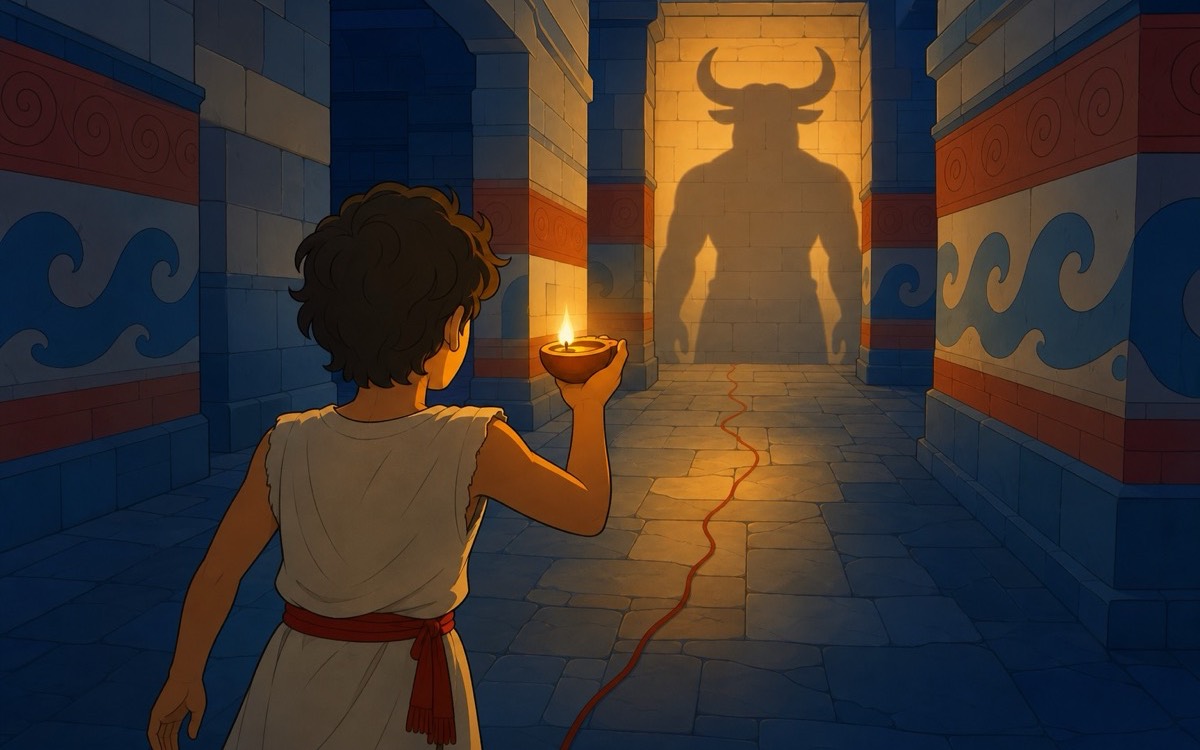
Short answer: Theseus and the Minotaur is a Greek myth, more than 2,500 years old, about a prince of Athens who goes into a maze on the island of Crete to face the Minotaur, a creature that is half man and half bull. Princess Ariadne gives him a ball of thread so he can find his way back out.
The story of Theseus and the Minotaur
The king and the creature
Long ago, the island of Crete was ruled by King Minos, the most powerful king of the sea. In his palace lived a strange creature: the Minotaur, with the body of a man and the head of a bull. Its name means "the bull of Minos".
The king did not want anyone to see it, so he asked Daedalus, the cleverest inventor in the world, to build a prison nobody could escape from. Daedalus built the Labyrinth: a maze of passages so twisting that whoever went in could never find the way out again.
Fourteen young Athenians
King Minos had won a war against the city of Athens. As a punishment, Athens had to send seven young men and seven young women to Crete, to be sent into the Labyrinth. In different versions of the story this happened every year or every nine years.
When the ship was ready once more, Theseus, the son of King Aegeus of Athens, said he would go as one of the fourteen. He promised his father he would face the Minotaur and come home.
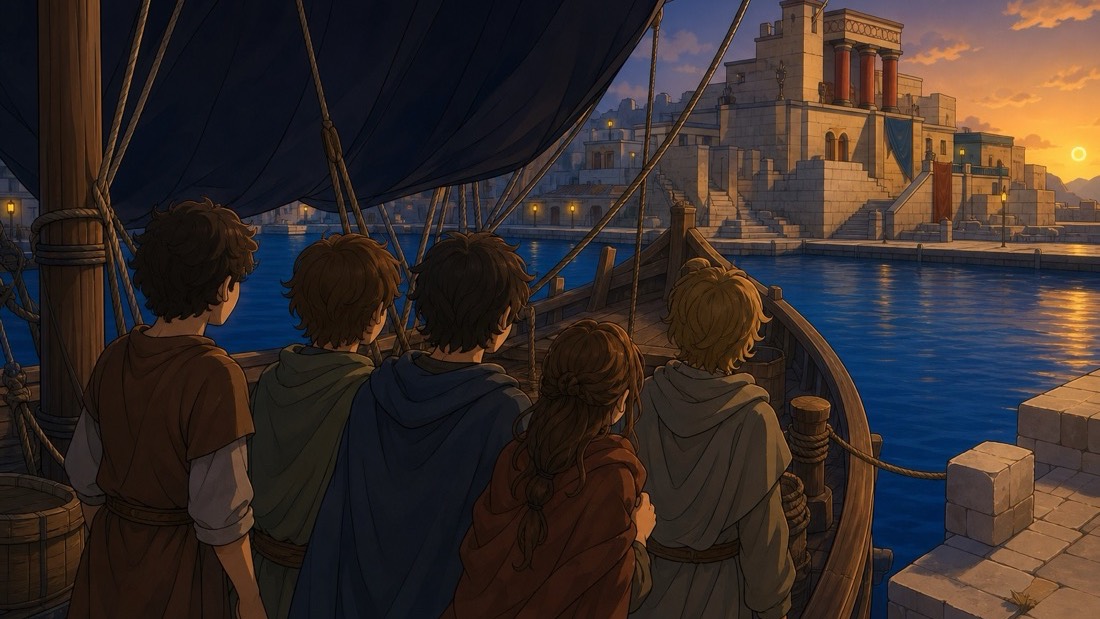
The ship sailed with black sails, for sadness. Theseus promised that if he came home alive, he would change them for white sails, so his father would know the news from far away.
Ariadne's thread
On Crete, King Minos's daughter Ariadne saw Theseus and decided to help him. She asked Daedalus how anyone could come out of the Labyrinth, and his answer was simple: tie a thread at the door and unwind it as you go.
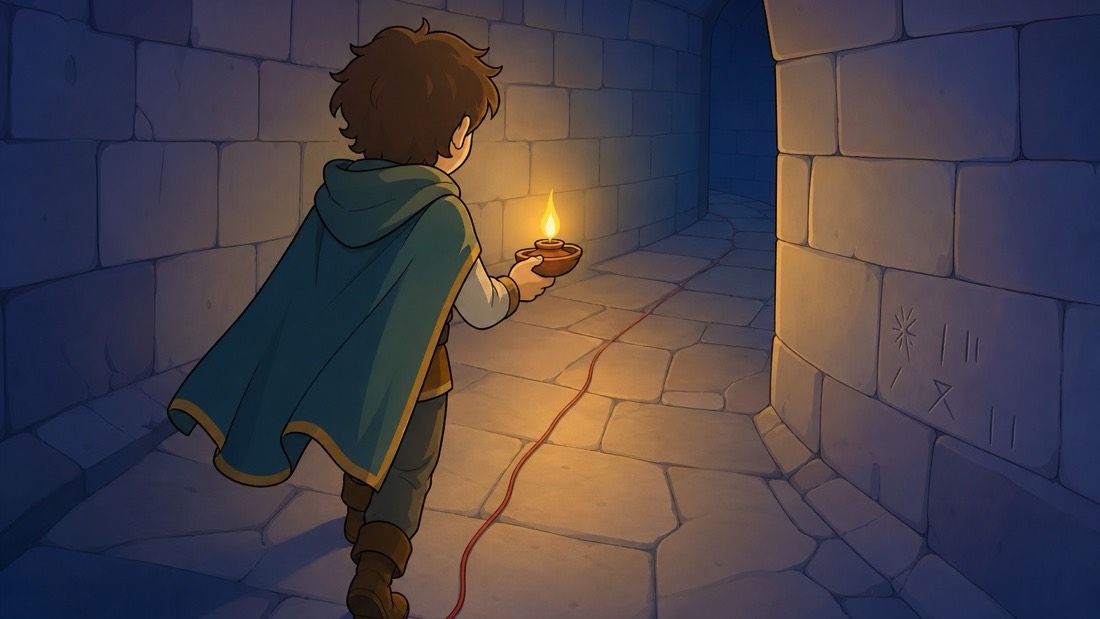
So Ariadne gave Theseus a ball of thread. He tied one end at the entrance and walked into the dark, letting the thread run out behind him.
Into the Labyrinth
Deep in the middle of the maze, Theseus found the Minotaur. In the old myth, they fought, and Theseus defeated it. Then he followed Ariadne's thread all the way back to the door, and led the other young Athenians out too.
The forgotten sails
Theseus and Ariadne sailed away from Crete together. In most versions, Theseus left Ariadne on the island of Naxos, where the god Dionysus found her and married her.
On the way home, Theseus forgot his promise: he did not change the black sails for white ones. His father, King Aegeus, waiting on a cliff, saw the black sails and thought his son was gone. Full of grief, he fell into the sea, and that sea has been called the Aegean Sea ever since. Theseus became king of Athens.
Was the Labyrinth real?
Nobody has found a maze like the one in the story. But the palace of Knossos on Crete is real, and it is about 3,500 years old. It had more than a thousand rooms, corridors, stairs and courtyards built around each other, so it may have felt like a maze to visitors.
The people of Knossos loved bulls. Their walls were painted with pictures of young acrobats leaping over the backs of charging bulls. The palace was also decorated with double-headed axes, and some historians think the word labyrinth comes from an old word for that axe, labrys.
Where does the word "clue" come from?
From this story. In old English, a ball of thread was called a clew. Because Theseus found his way out of the Labyrinth by following a clew, the word slowly came to mean anything that helps you solve a puzzle. Today we spell it clue.
What does the myth teach?
- Bravery is not the same as fighting. Theseus volunteers to go when he could have stayed safe.
- Help comes from others. He would never have come out without Ariadne and Daedalus's idea.
- Keep your promises. Forgetting one small promise, the sails, leads to the saddest part of the story.
There is also a real trick for mazes hidden in it: in a maze whose walls are all joined together, if you keep one hand on the wall and never let go, you will always find the way out.
10 facts about Theseus and the Minotaur for kids
- The Minotaur was half man and half bull.
- Its name means "the bull of Minos".
- Daedalus, who built the Labyrinth, was also the father of Icarus, who flew too close to the Sun.
- Athens sent fourteen young people to Crete: seven boys and seven girls.
- Ariadne was the daughter of King Minos.
- Theseus found his way out by following a ball of thread.
- The word "clue" comes from "clew", an old word for a ball of thread.
- The Aegean Sea is named after Theseus's father, King Aegeus.
- The palace of Knossos on Crete is real and about 3,500 years old.
- Paintings at Knossos show young people leaping over bulls.
Step into the Labyrinth in a story
In our adventure The Labyrinth of the Minotaur, your child is Alex, the youngest of the fourteen Athenians. They calm a frightened friend on the ship, win over Ariadne, learn the Labyrinth's secret from Daedalus, tie the red thread at the bronze doors and go into the dark. Prince Theseus wants to fight, and your child can find a better way.
In the myth the Minotaur is defeated. In this version nobody is hurt, and what really waits in the Labyrinth is a mystery for your child to solve. You can play the first moment free, no sign-up needed, or see our other Greek mythology games for kids.
Roll for Wonder
A tabletop adventure your child leads.
Explore illustrated worlds, meet characters and solve problems together. Play a moment of it right now, no sign-up needed.