Guides ·
Choose-your-path books in the classroom: one book, 25 kids
Three ways to play a printable choose-your-path gamebook with a whole class or with siblings: who reads, who rolls, who keeps the clues.
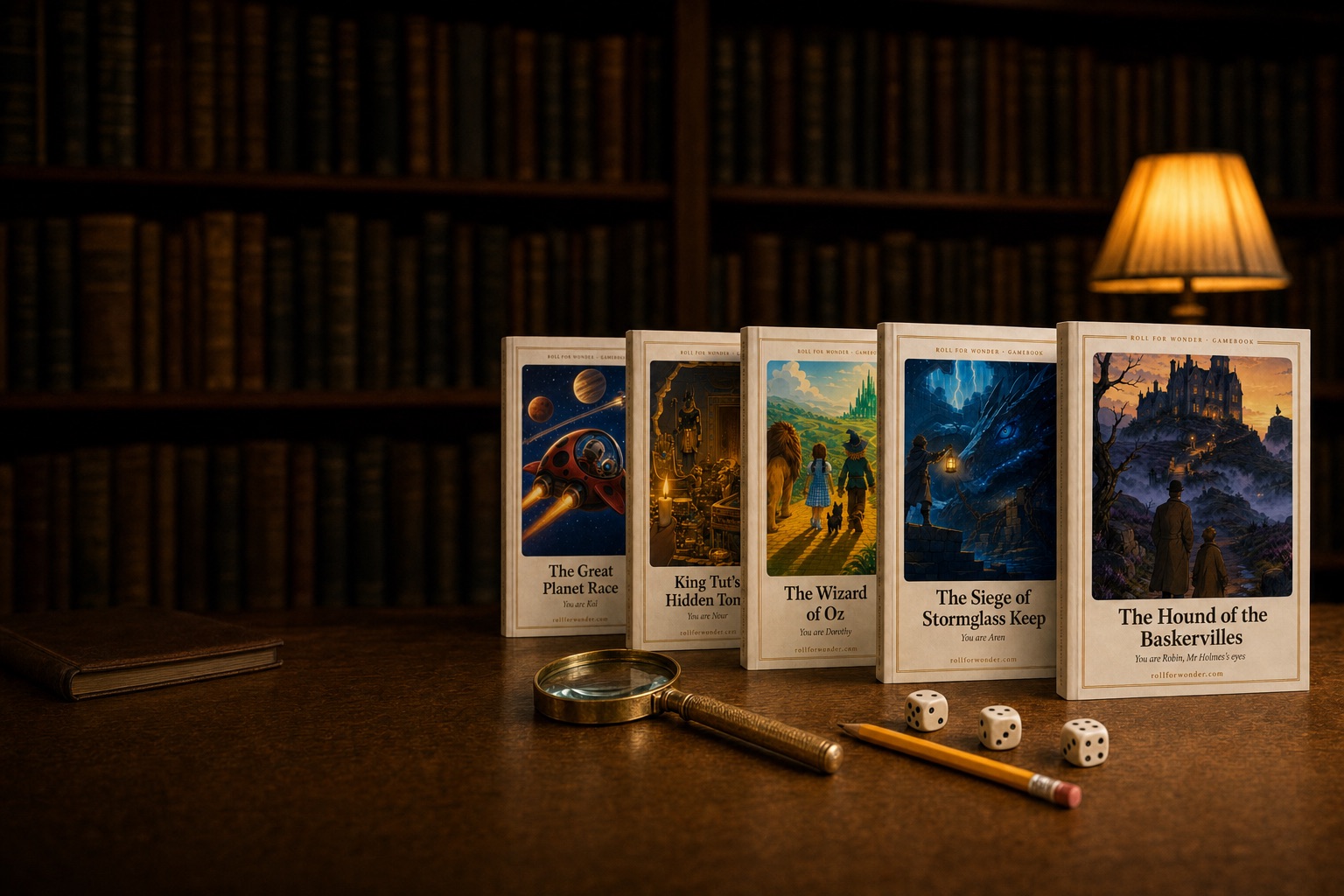
Short answer: put the gamebook on the board, read one numbered section at a time, let the class vote on each choice, and give the die, the reading and the case sheet to different children. A chapter fits in one lesson of about 45 minutes. For group work, print one copy for every group of three to five.
A choose-your-path gamebook is a story cut into numbered sections. At the end of each one the reader chooses what to do and turns to the section with that number. Ours add a die for the uncertain moments and a case sheet where clues are written down. That makes them work unusually well in a classroom: every choice is a small debate, and every clue is a reason to read carefully.
Way 1: the whole class plays one hero
Best for a first time, and for ages 6 to 9.
- Show the PDF on the board. Every number in our gamebooks is a link, so tapping it jumps to that section.
- One child reads the section aloud, or the teacher reads to younger classes.
- The class votes on the choice. Hands up, or coloured cards for "A" and "B". Before the vote, ask two children to say why.
- One child rolls the die when the book asks for it, and the class adds the hero's number out loud.
- One child keeps the case sheet on the board: clues, things in the bag, codewords.
Change the reader, the roller and the scribe at every section, and everyone gets a turn by the end of the lesson.
Way 2: groups of three to five
Best for ages 9 to 12, once the class knows how it works.
Print one copy for each group, or just the chapter you are playing. Give each child a job and swap them at every chapter:
- The reader reads each section aloud to the group.
- The roller rolls the die and does the sum.
- The scribe keeps the case sheet.
- The detective looks back over the clues before each choice and says what they think.
At the end, the groups compare: which ending did you reach? Which clue did you miss? Groups that took different paths have a lot to tell each other.
Way 3: alone, in reading time
A gamebook is a good book for a child who "doesn't like reading": they choose what happens, and nobody reads them a whole page at once. It also works for children who finish early, and they can start again to find another ending.
What children practise
- Reading carefully. A missed sentence can mean a missed clue, and children notice it themselves when they don't reach the best ending.
- Drawing conclusions. Clues carry numbers, and at the end two of them add up to the section where the answer is. Nobody can guess it or find it by flipping pages.
- Chance and probability. "You need 4 or more on one die. Is that likely?" There are three good faces out of six, so it's an even chance. Adding the hero's number changes the odds, and the class can see it.
- Arguing for a choice. Voting works best when two children first say why.
- Writing. After the book, children want to write their own. Our free template for a choose-your-path story has a story map and section cards.
Which book for which topic
Each gamebook is a whole story about one subject, so it can open a topic or close one:
- Ancient Egypt: King Tut's Hidden Tomb
- Ancient Rome and volcanoes: The Last Day of Pompeii
- Greek myths: The Labyrinth of the Minotaur
- The solar system: The Great Planet Race
- Space and black holes: The Voice at the Edge of the Black Hole
- Medieval legends: King Arthur: The Squire of Camelot
- Classic novels: The Hound of the Baskervilles, Treasure Island, Alice in Wonderland, The Wizard of Oz and Journey to the Center of the Earth
Printing for a class
A gamebook you buy may be printed as many times as you like for your own family or for one classroom. The case sheet comes as a separate file, so each group or each child can have a clean one. Please don't share the file with other classes or schools.
At home, with children of different ages
Homeschooling families and siblings can play like a small class. The oldest reads, the youngest rolls the die, and the middle one keeps the case sheet. The youngest still decides at every vote, and the oldest gets to explain the clues.
Try it free first
Download the first chapter of The Hound of the Baskervilles for free: 37 numbered sections, the case sheet and the rules, enough for one lesson. All twelve gamebooks are on the gamebooks shelf.
Roll for Wonder
A tabletop adventure your child leads.
Explore illustrated worlds, meet characters and solve problems together. Play a moment of it right now, no sign-up needed.