Guides ·
Solo RPG for kids: role-playing games a child can play alone
What a solo role-playing game is, which kinds suit children of 6 to 12, and how a child can play a whole adventure without a game master.
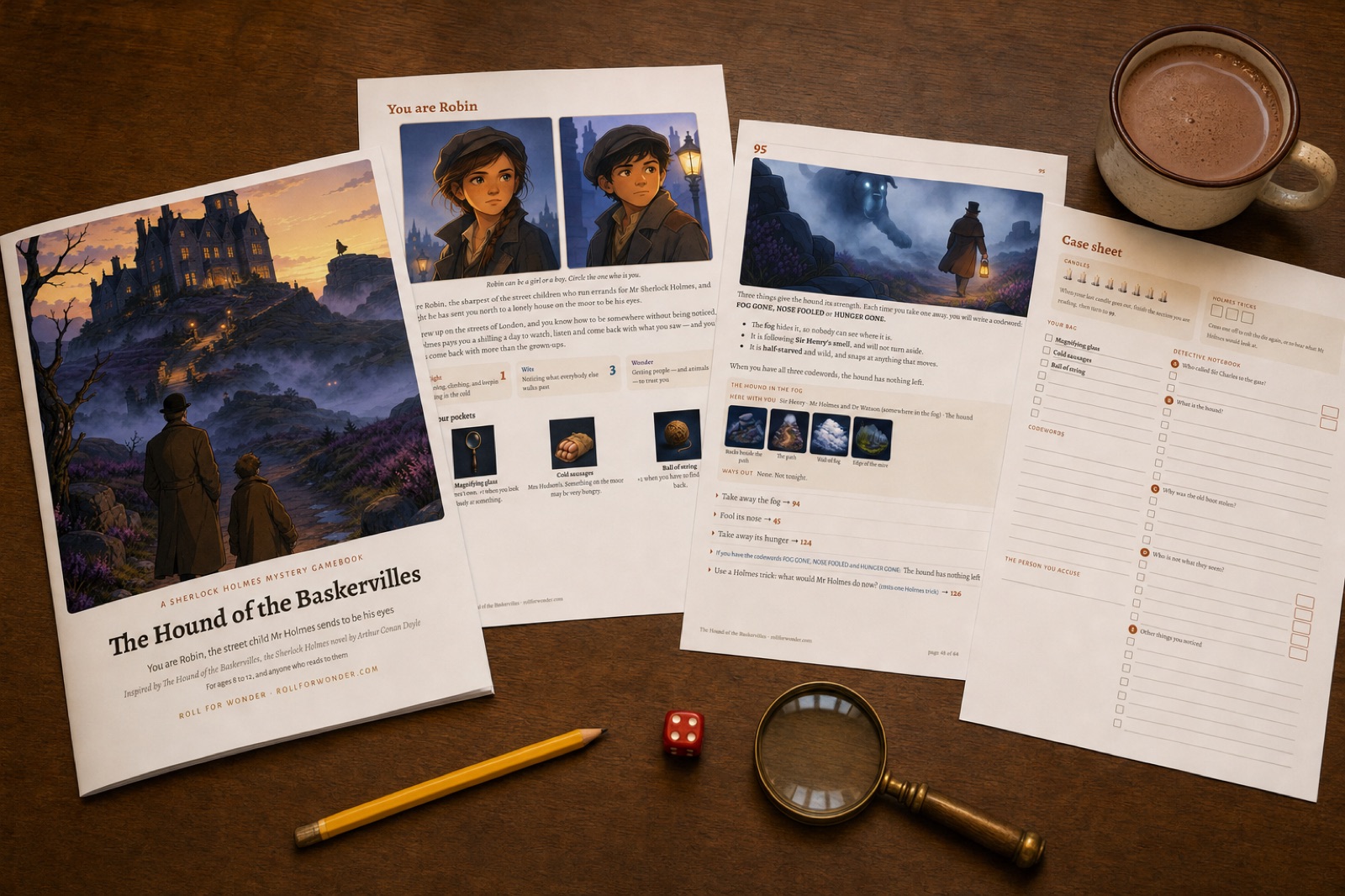
Short answer: a solo RPG is a role-playing game for one player, with no game master. For children, the best ones are gamebooks with a die: the child is the hero, the book tells the story in numbered sections, a die decides the uncertain moments and a sheet keeps track of clues and things carried. From about 8, a child who reads on their own can play one alone. Younger children play with a grown-up reading aloud.
What makes a game a solo RPG
A role-playing game has three things: you play a character, you decide what they do, and the rules decide what happens when it's uncertain, usually with a die. In a group game, one person, the game master, tells the story and plays everyone else. In a solo game that job is done by something else: a book, a deck of cards, a set of tables, or a computer.
Three kinds, and which suit children
1. Gamebooks with a die. The story is cut into numbered sections. At the end of each one the child chooses and turns to that number. The hero has a few numbers of their own, carries things, and rolls a die when something might go wrong. This is the easiest way in: everything is written, nothing has to be invented, and a child can play it in bed, in a car or at the kitchen table.
2. Journaling and oracle games. The player rolls on tables or draws cards and writes the story themselves. They're wonderful for teenagers and adults who love writing, but they ask a lot of a young child: the game gives a prompt and the child has to make everything else up.
3. Story games on a screen. The computer plays the game master. The child chooses or types what their hero does, and the story answers. This keeps the freedom of a real role-playing game, the "can I try this instead?", without needing a grown-up who knows the rules.
For most children of 6 to 12, the first and third kinds work best, and many families use both.
What to look for
- Simple numbers. Three numbers for the hero (say Strength, Smarts and Heart) and one ordinary die are plenty.
- A miss that doesn't end the game. Being sent back to page one after one bad roll puts children off. A good solo game makes a miss cost something and lets the story go on.
- A real puzzle. Clues to collect and a mystery to solve give the child something to think about between rolls, not only luck.
- More than one ending. It makes children play again, and play more carefully.
- About an hour. Long enough to feel like an adventure, short enough for one evening.
Our printable gamebooks
Every Roll for Wonder gamebook is a solo RPG made for children of 8 to 12: a hero with three numbers, things in a bag, one six-sided die, a case sheet for clues and more than one ending. Nobody dies, and a miss always lets the story go on. They are PDFs to print or to play on a tablet, where every number is a link.
You can download the first chapter of The Hound of the Baskervilles free: 37 numbered sections, the rules and the case sheet. It's enough to see whether your child enjoys playing alone.
When your child wants more freedom
A gamebook has a set number of paths. Children who keep asking "but what if I…" are ready for a game that answers anything. Roll for Wonder's adventures online work like a solo role-playing game in the browser: the game tells the story and plays every character, the child chooses or types their own idea, and a die decides the uncertain moments. The same stories exist in both forms, so a child can play the book and then the adventure, or the other way round. For more games of this kind, with and without a game master, see games like D&D for kids.
Can a younger child play a solo RPG?
Yes, with a grown-up reading. A six- or seven-year-old can make every choice and roll the die while you read the section aloud and keep the sheet. It's still their game: they decide everything, you just turn the pages. For more on playing role-playing games with young children, read how to play a tabletop RPG with a six-year-old.
Roll for Wonder
A tabletop adventure your child leads.
Explore illustrated worlds, meet characters and solve problems together. Play a moment of it right now, no sign-up needed.